
Laboratory projects
These are major and often funded projects in the CogNeW laboratory that often involve multiple students or staff members.

Individual differences in cognition & brain organization
Over the past 20 years, the study of functional brain networks has helped us understand how brain regions interact to bring about complex cognitive functions such as cognitive control. However, functional networks mapped within individuals differ greatly, and especially in regions involved in attention and cognitive control. These functional network maps in individuals often do not coincide with group-average task-activity maps in between-subjects’ studies. This fact opens the door for opportunities to study networks within individuals, whether they relate to individual differences in behavior, and how they can guide treatments. We use rest and task-based fMRI to inform our understanding of human cognition by mapping functional networks within individuals and examining the relationship between these individually-estimated networks and cognitive functions. Through this effort, we can better inform targets for neuromodulation and potentially enhance cognitive abilities.
Left: even in two individuals, we can see significant variability in where fMRI finds networks of interest. We ask: “What does this mean?”
-
Research Gift, Starfish Neuroscience, LLC Total costs: $500,000
Research Gift, Anonymous Donor Total costs: $20,000
NIH NRSA, Student Doctoral Fellowship to Fareshte Erani Total costs: $135,000
NIH Director’s Early Independence Award (EIA) (Completed) Total costs: $2,000,000
-
Cember, A.T.J., Deck, B.L., Kelkar, A., Faseyitan, O., Zimmerman, J.P., Erickson, B.A., Elliott, M., Coslett, H.B., Hamilton, R.H., Reddy, R., Medaglia, J.D. (2022). Glutamate-Weighted Magnetic Resonance Imaging (GluCEST) Detects Effects of Transcranial Magnetic Stimulation to the Motor Cortex. NeuroImage, 256, 119191.
Erani, F., McKeever, J., Medaglia, J.D., & Schultheis, M.T. (2022). The Relationship between Fatigue and a Clinically Accessible Measure of Switching in Individuals with Multiple Sclerosis. The Archives of Clinical Neuropsychology. https://doi.org/10.1093/arclin/acac017Juarascio, A., Presseller, E.K., Michael, M.L., Kelkar, A.S., Srivastava, P., Chen, J.Y., Dengler, J., Manasse, S.M., Medaglia, J.D. (2022). Correcting the reward imbalance in binge eating: A pilot randomized trial of a novel reward re-training treatment. Appetite, 106103
Yeager, B.E., Dougher, C.C., Cook, R.H. & Medaglia, J.D. (2021). The Role of Transcranial Magnetic Stimulation in Understanding Attention-Related Networks in Single Subjects. Current Research in Neurobiology, 2, 100017.
Tardiff, N., Medaglia, J.D., Bassett, D.S., & Thompson-Schill, S.T. (2021). The modulation of brain network integration and arousal during exploration. NeuroImage, 240, 118369.Ye, C., Slavakis, K., Nakuci, J., Muldoon, S.F., & Medaglia, J.D. (2021). Fast Sequential Clustering in Riemannian Manifolds for Dynamic and Time-Series-Annotated Multilayer Networks. IEEE Signal Processing, 2, 67-84.
Ye, C., Slavakis, K., Patil, P. V., Muldoon, S. F., & Medaglia, J.D. (2021). Brain-Network Clustering via Kernel-ARMA Modeling and the Grassmannian. IEEE Signal Processing, 179, 107834.
Oathes, D.J., Balderston, N.L., Kording, K.P., DeLuisi, J.A., Perez, G.M., Medaglia, J.D., Fan, Y., Duprat, R.J., Satterthwaite, T.D., Sheline, Y.I., Linn, K.A. (2021). TMS/fMRI for Probing and Modulating Neural Circuits Relevant to Affective Disorders. WIRE: Cognitive Science, e1553.
Wang, Y., Metoki, A., Smith, D.V., Medaglia, J.D., Zang, Y.Y., Benear, S., Lin, Y., & Olson, I.R. (2020). Multimodal Mapping of the Face Connectome. Nature Human Behaviour, 1-15.
Betzel, R.F., Medaglia, J.D., Kahn, A.E., Soffer, J., Schonhaut, D.R., & Bassett, D.S. (2019). Inter-regional ECoG correlations predicted by communication dynamics, geometry, and correlated gene expression. Nature Biomedical Engineering, 1.
^Medaglia, J.D., Erickson, B., Zimmerman, J., & Kelkar, A. (2019). Personalizing Neuromodulation. International Journal of Psychophysiology, 154, 101-110.
Medaglia, J.D., Huang, W., Karuza, E., Thompson-Schill, S.L., Ribeiro, A., & Bassett, D.S. (2018). Functional Alignment with Anatomical Networks is Associated with Cognitive Flexibility. Nature Human Behaviour, 2(2), 156.
Medaglia, J.D., Satterthwaite, T.D., Moore, T.M., Ruparel, K., Gur, R.C., Gur, R.E. Gu, S., Yang, M., Bassett, D.S. (2018). Brain state expression and transitions are related to complex executive cognition in normative neurodevelopment. NeuroImage, 166, 293-306.Medaglia, J.D. (2018). Clarifying Cognitive Control and the Controllable Connectome. WIRE: Cognitive Science, doi: 10.1002/wcs.1471.
Khambhati, A., Medaglia J.D., Karuza, E.A., Thompson-Schill, S.T., & Bassett, D.S. (2018). Subgraphs of functional brain networks identify dynamical constraints of cognitive control. PLOS Computational Biology, 14(7), e1006234.
Kenett, Y., Beaty, R.E., & Medaglia, J.D. (2018). A computational network control theory analysis of depression symptoms. Personality Neuroscience, 1.
Kenett, Y.N., Medaglia, J.D., Beaty, R.E., Chen, Q., Thompson-Schill, S.L., & Qiu, J. (2018). Driving the brain towards creativity and intelligence: A network control theory analysis. Neuropsychologia, 118, 79-90.
Fisher, A.F., Medaglia, J.D., & Jeronimus, B. (2018). A lack of group-to-individual generalizability is a threat to human subjects research: Evidence from six independent samples. Proceedings of the National Academy of Sciences, 201711978.
Fisher, A.F., Reeves, J.W., Lawyer, G., Medaglia, J.D., & Rubel, J.A. (2017). Exploring the Idiographic Dynamics of Mood and Anxiety via Network Analysis. Journal of Abnormal Psychology, 126(8):1044-1056
Medaglia, J.D., (2017). Graph Theoretic Analysis of Resting State fMRI. Neuroimaging Clinics of North America, 27, 593-607.
Medaglia, J.D., Pasqualetti, F., Hamilton, R.H., Thompson-Schill, S.L, Bassett, D.S. (2017). Brain and Cognitive Reserve: Translation via Network Control Theory. Neuroscience & Biobehavioral Reviews, 75, 53-64.
Medaglia, J.D., Lynall, M.E., & Bassett, D.S. (2015). Cognitive Network Neuroscience. The Journal of Cognitive Neuroscience, 27(8): 1471-1491.
Gu, S., Satterthwaite, T.D., Medaglia, J.D., Gur, R.E., Gur, R.C., Bassett, D.S. (2015). Emergence of System Roles in Normative Neurodevelopment. Proceedings of the National Academy of Sciences. 112(44), 13681-13686.
Gu, S., Pasqualetti, F., Cieslak, M., Telesford, Q., Yu, A., Kahn, A., Medaglia, J.D., Vettel, J., Miller, M., Grafton, S.T., & Bassett, D.S. (2015). Controllability of Structural Brain Networks. Nature Communications, 6, 8114.
Medaglia, J.D. VanKirk, K.K., Oswald, C.B., & Church, L.W.P. (2015). Interdisciplinary Differential Diagnosis and Care of a Patient with Atypical Delusional Parasitosis due to early HIV-related Dementia. The Clinical Neuropsychologist, 29(4): 559-569.
Medaglia, J.D., McAleavey, A.A., Rostami, S., Slocomb, J. & Hillary, F.G. (2015). Modeling distinct imaging hemodynamics early after TBI: the relationship between signal amplitude and connectivity. Brain Imaging and Behavior, 9(2): 285-301.
Hillary, F.G., Rajtmajer, S.M., Roman, C., Medaglia, J.D., Slocomb, J., Good, D.C., & Wylie, G.R. (2014). The rich get richer: brain injury elicits hyperconnectivity in core subnetworks. PLoS ONE, 9(8), e104021.
Hillary, F.G., Medaglia, J.D., Gates, K.M., & Good, D.C. (2014). Examining network dynamics after traumatic brain injury using the extended unified SEM approach. Brain Imaging and Behavior, 8(3), 435-445.
Bryer, E.J., Medaglia, J.D., Rostami, S., & Hillary, F.G. (2013). Neural recruitment after mild traumatic brain injury is task dependent: A meta-analysis. Journal of the International Neuropsychological Society, 19(7), 751-762.
Medaglia, J.D., Chiou, K.S., Slocomb, J., Fitzpatrick, N.M., Wardecker, B.M., Ramanathan, D., Vesek, J., Good, D.C., & Hillary, F.G. (2012). The less BOLD, the wiser: support for latent resource hypothesis after neurotrauma. Human Brain Mapping, 33(4), 979-993.
Medaglia, J.D., Ramanathan, D., Venkatesan, U.M., & Hillary, F.G. (2011a). Non-Ergodicity in Neural Networks. Network: Computation in Neural Systems, 22 (1-4), 148-153.
Hillary, F.G., Slocomb, J., Hills, E., Fitzpatrick, N., Medaglia, J.D., Wang, J., Good, D., & Wylie, G. (2011). Changes in Resting Connectivity during Recovery from Severe Traumatic Brain Injury. International Journal of Psychophysiology, 82(1), 115-123.
Hillary, F.G., Medaglia, J.D., Gates, K., Molenaar, P., Slocomb, J., Peechatka, A., Good, D. (2011). Examining working memory task acquisition in a disrupted neural network. Brain, 134(5), 1555-1570.
Hillary, F.G., Genova, H.M., Medaglia, J.D., Fitzpatrick, N.M., Chiou, K.S., Wardecker, B.M., Franklin, R.G., Wang, J., & DeLuca, J. (2010). The Nature of Processing Speed Deficits in Traumatic Brain Injury: is Less Brain More? Brain Imaging and Behavior, 4(2), 141-154.
Ruocco, A.C., Medaglia, J.D., Ayaz, H., & Chute, D.L. (2010). Abnormal prefrontal cortical response during affective processing in borderline personality disorder. Psychiatry Research: Neuroimaging, 182(2), 117-122.
Ruocco, A.C., Medaglia, J.D., Tinker, J.R., Ayaz, H., Forman, E. M., Williams, J. M., Hillary, F.G., Platek, S., Onaral, B., & Chute, D.L. (2010). Medial Prefrontal Cortex Hyperactivation during Social Exclusion in Borderline Personality Disorder. Psychiatry Research: Neuroimaging, 181(3), 233-236.

Network Neuroscience in Aphasia - What is the basis of language loss and outcomes?
The human brain features structurally and functionally connected regions we understand as a network. Our lab is interested in determining how the properties of brain networks shape cognition, specifically the neurobiology of language. To do so, we use various neuroimaging methods to distill the complexity of the brain into a network and then examine how topological properties of brain regions are related to language. We also extend this work to patients with language deficits, such as chronic stroke (aphasia) and neurodegenerative disease (primary progressive aphasia). Using quantitative network models and measures, we can distinguish how a healthy brain network differs from a patient brain, how those differences correspond to language deficits, and if neuromodulation can improve patient outcomes using a network-guided approach.
Left: Image of connections lost in a left hemisphere stroke. Damage to the brain to even apparently small parts of the brain can have large impacts on the overall network. We ask: “What network properties best characterize behavior and outcomes?”
-
NIH R01-AG-059763, Roy Hamilton (PI, University of Pennsylvania) Total costs: $3,000,000
R01-DC-16800-01A1 Coslett (PI, University of Pennsylvania) Total costs: $3,000,000
R01-DC-014960-01A1, Peter Turkeltaub (PI, Georgetown University) (Completed) Total costs: $3,500,000
Translational Neuroscience Initiative, Roy Hamilton (PI, University of Pennsylvania) (Completed) Total costs: $400,000
-
Medaglia, J.D., Erickson, B.A., Pustina, D., Kelkar, A.S., DeMarco, A.T., Dickens, J.V., Turkeltaub, P.E. (2022). Simulated attack reveals how lesions affect network properties in post-stroke aphasia. The Journal of Neuroscience, 42 (24), 4913-4926
Erickson, B.A., Kim, B., Deck, B.L., Pustina, D., DeMarco, A.T., Dickens, V., Kelkar, A.S., Turkeltaub, P.E., Medaglia, J.D. (2022). Glass Half Full: Preserved Anatomical Bypasses Predict Variance in Language Functions After Stroke. Cortex. doi:10.1016/j.cortex.2022.05.023
McCall, J. D., Dickens, J. V., Mandal, A. S., DeMarco, A. T., Fama, M. E., Lacey, E. H., ... & Turkeltaub, P. E. (2022). Structural disconnection of the posterior medial frontal cortex reduces speech error monitoring. NeuroImage: Clinical, 33, 102934.
Medaglia, J.D., Harvey, D.Y., Kelkar, A.S., Zimmerman, J.P., Mass, J., Bassett, D.S., & Hamilton, R.H. (2021). Language Tasks and the Network Control Role of the Left Inferior Frontal Gyrus. eNeuro, 8 (5).
Dickens, J.V., DeMarco, A.T., van der Stelt, C.M., Snider, S.F., Lacey, E.H., Medaglia, J.D., Friedman, R.B., Turkeltaub, P.E. (2021). Two types of phonological reading impairment in stroke aphasia. Brain Communications, 3(3), fcab194.
Olsen, A., … Medaglia, J.D., et al. (2020). Toward a Global and Reproducible Science for Brain Imaging in Neurotrauma: The ENIGMA Adult Moderate/Severe Traumatic Brain Injury Working Group. Brain Imaging & Behavior, 1-29.
Medaglia, J.D., Harvey, D.Y., White, N., Kelkar, A., Zimmerman, J., Bassett, D.S., Hamilton, R.H. (2018). Network Controllability in the Inferior Frontal Gyrus Relates to Controlled Language Variability and Susceptibility to TMS. The Journal of Neuroscience, 0092-17.
Pustina, D., Avants, B., Faseyitan, O., Medaglia, J.D., Schwartz, M., Coslett, H.B. (2018). Improved accuracy in lesion to symptom mapping with multivariate sparse canonical correlations. Neuropsychologia, 115, 154-166.
Medaglia, J.D., Huang, W., Segarra, S., Olm, C., Gee., J., Grossman, M., Ribeiro, A., McMillan, C. Bassett, D.S. (2017). Brain network efficiency is influenced by the pathologic source of corticobasal syndrome, Neurology, 89(13), 1373-1381.
Medaglia, J.D. (2017). Functional Neuroimaging in TBI: From Nodes to Networks. Frontiers in Neurology, 8, 407.Pustina, D., Coslett, H. B., Ungar, L., Faseyitan, O. K., Medaglia, J. D., Avants, B., & Schwartz, M. F. (2017). Enhanced estimations of post‐stroke aphasia severity using stacked multimodal predictions. Human Brain Mapping, 38(11), 5603-5615.

Developing Novel Neurotechnologies for Imaging and Stimulation
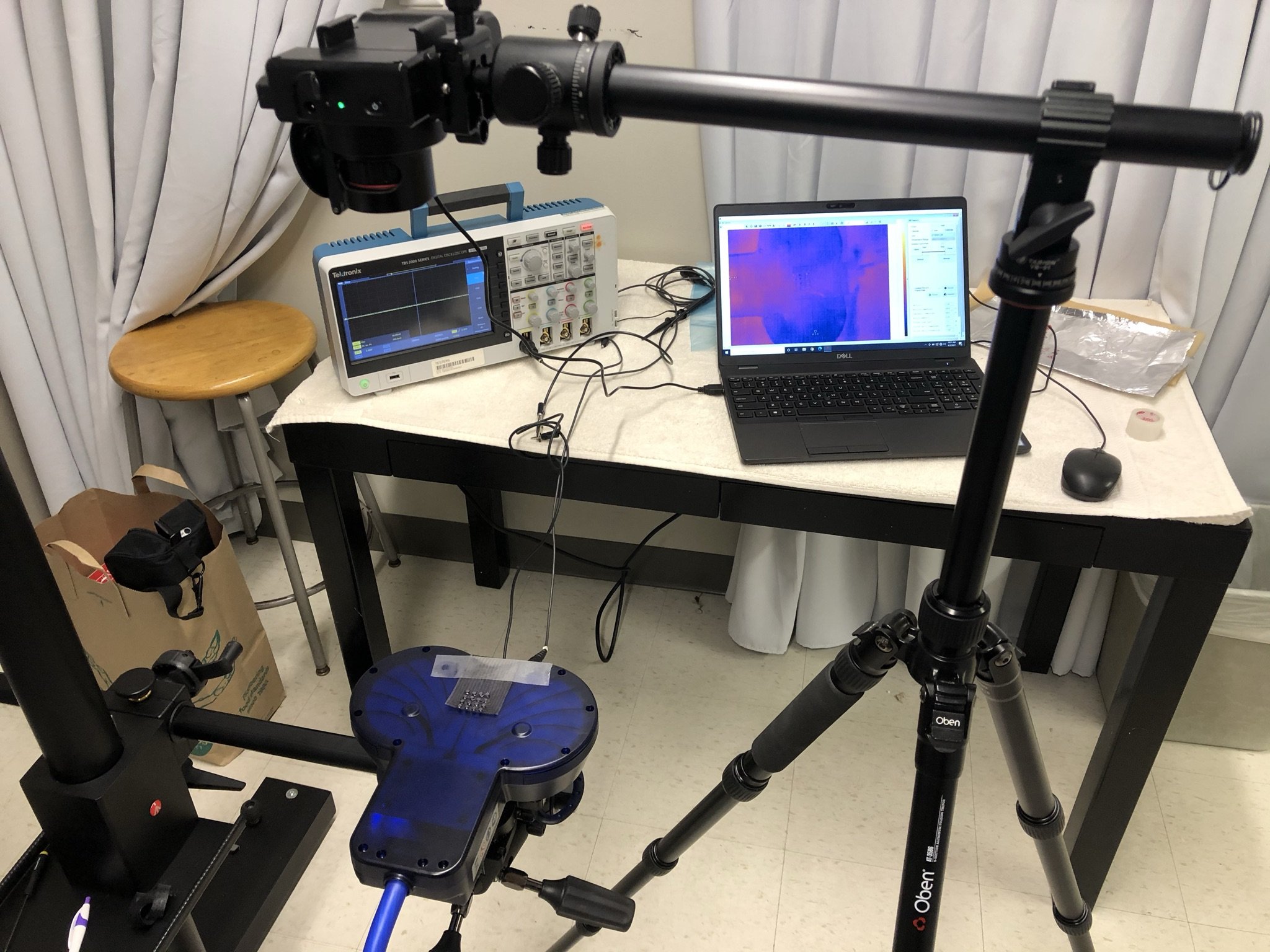
While individualized brain mapping helps solve the question of where to stimulate, a challenge in cognitive enhancement is when to stimulate. EEG has been a mainstay in brain monitoring for over 100 years. However, most EEG research has only studied what brainwaves look like after the fact - for example, how they change when people do a difficult mental task versus rest. Using advanced systems, it is possible to "close the loop" and do experiments that track and intervene on ongoing brainwaves to improve cognition. For example, a "closed-loop EEG system might monitor a particular brainwave, and then trigger transcranial magnetic stimulation (TMS) to fire exactly when that brainwave reaches a peak. There is increasing evidence that this timing is an important determinant of TMS effects on the brain and cognition. We have several projects focused on tracking, resetting, and controlling brain phases.
Left, Top: Benchmarking software for brain tracking and triggered TMS.
Left, Bottom: Testing whether next-generation electrodes are TMS-compatible.
-
R01-NS121219-01 Vitale, Medaglia (MPI) Total costs: $2,250,000
-
This is a new area of funding and several projects are being prepared for submission for peer review.
Driscoll, N., … Medaglia, J.D., & Vitale, F. (2021). MXtrodes: MXene-infused bioelectronic interfaces for multiscale electrophysiology and stimulation. Science Translational Medicine, 13 (612), eabf8629.

Even when people think a use of brain stimulation is morally acceptable, they still might not be willing to use it. Why?
Public Opinions About Brain Stimulation & Neurolaw
We have performed several studies of public attitudes about whether it is right and wrong to use brain stimulation and how risks and benefits influence decisions. In addition, we have provided critiques of how assumptions of brain function should or should not influence legal practices and under what conditions brain stimulation is a threat to human autonomy.
-
Most of the work in this area has been supported by internal funds or donations provided by Starfish Neuroscience, LLC, and an anonymous donor.
-
Fernandez, K.A., Hamilton, R.H., Cabrera, L.Y., & Medaglia, J.D. (2022). Context-dependent Risk & Benefit Sensitivity Mediate Judgments About Cognitive Enhancement. AJOB Neuroscience, 13(1), 73-77.
Kuersten, A., & Medaglia, J.D. (2021). Neuroscience and the Model Penal Code’s Mens Rea Categories. Duke Law Journal Online, 71.
Haslam, M.H., Yaden, D.Y., & Medaglia, J.D. (2021). Moral framing and mechanisms influence public willingness to optimize cognition. Journal of Cognitive Enhancement, 5, 176-187.
Medaglia, J.D., Hamilton, R.H., & Kuersten, A. (2020). Protecting Decision Making in the Era of Neuromodulation. The Journal of Cognitive Enhancement, 4, 469-481.
Medaglia, J.D., Haslam, M., Helion, C., & Yaden, D. (2019). Moral Attitudes and Willingness to Enhance and Repair Cognition with Brain Stimulation. Brain Stimulation, 12(1), 44-53.
Yaden, D.B., Eichstaedt, J., Medaglia, J.D. (2018). The Future of Technology in Positive Psychology: Methodological Advances in the Science of Well-being. Frontiers in Psychology, 9, 962.